

Vape brand product launch marketing is the coordinated plan that takes a new vaping product from regulatory clearance to its first sales, using only the channels that platforms and regulators allow. For a vape brand, the plan starts with a compliance check and then leans on owned and earned channels: search, a launch page, email, retailer and distributor enablement, and independent reviews. Paid social, paid search and SMS are mostly closed to the category.
Short answer. Confirm the product's regulatory status first. Build the launch around an indexable product entity (brand, device, flavor, strength) with its own page, schema and supporting content. Use email and B2B channels for reach. Treat influencers and review programs as a compliance risk, not a shortcut. This guide is written for brand owners and the SEO or marketing teams who run launches. Facts were checked on 18 November 2026. It is not legal advice, so have counsel review claims, warnings and state rules before anything goes live.
Why is a vape product launch different from a normal e-commerce launch?
A vape launch differs because the product's legal status, the ad platforms and the messaging channels each limit what you can do. A launch calendar built for a consumer gadget will break on all three.
- Authorization is the gate. New tobacco products need an FDA marketing granted order before they are marketed. As of August 2026, FDA had authorized 48 e-cigarette products, and the May 2026 authorization of four Glas pods was the first time fruit-flavored products cleared the PMTA pathway. Most flavored applications have still ended in denial, according to trade reporting. Your marketing plan depends on which side of that line your product sits.
- Enforcement priorities shifted in 2026. FDA's final guidance of 8 May 2026 sets three inventory tiers: products with a marketing granted order, products with an accepted and filed PMTA, and products with no PMTA or a denied one. It does not legalize unauthorized products, so a launch plan for a tier-two or tier-three product carries risk that a tier-one launch does not.
- States add their own gates. PMTA directory laws list which products may be sold. North Carolina's registry went live on 1 May 2026, and Virginia and Wisconsin followed on 1 July, per Token of Trust. A product can be federally authorized and still be absent from a state list, so launch geography is a compliance decision first.
- Paid channels are closed. Google bars e-cigarettes and e-juice from Shopping ads and free listings, Meta's ad standards treat e-cigarette promotion as non-compliant, and TikTok's ad policy lists e-cigarettes and vape products as prohibited. Mobile messaging is restricted too, covered below.
What should be cleared before any launch marketing starts?
Clear four items before the first asset is published: regulatory status, claims, warnings and geography. Record the answers in one internal launch brief so every writer, agency and reseller works from the same facts.
| Check | Question to answer | What to do with the answer |
|---|---|---|
| Regulatory status | Does each SKU have a marketing granted order, a pending PMTA or neither? | Match the product to the tiers in FDA's May 2026 enforcement guidance. Verify on FDA's marketing orders page, not from a supplier's word. |
| Claims | Which statements about harm, risk or quitting appear anywhere in the launch? | Remove health and reduced-risk claims unless counsel confirms a legal basis. Describe the product's features, not its health effects. |
| Warnings | Does every ad and product page carry the required nicotine warning? | Trade guidance says every nicotine e-cigarette advertisement must carry FDA's addictiveness warning. Confirm the exact wording and placement with counsel. |
| Geography | Which states list the product, restrict flavors or ban online sales? | Publish the ship-to map and block excluded states at checkout. Mark non-shipping states honestly in shipping markup. |
| Age assurance | Where is age checked? | Check at checkout without hiding pages from crawlers. See our guide to age verification software for vape websites. |
Which marketing channels are open to a vape brand launch?
Owned search, email, retailer programs and earned media are the realistic core. Each paid or messaging channel below has a documented restriction, but policies change, so read the current text before you plan around any of them.
| Channel | Status for vape brands | Basis | Launch use |
|---|---|---|---|
| Google Ads and Shopping | Not available for e-cigarettes and e-juice | Merchant Center Dangerous products policy; November 2023 e-juice update | None. Invest in organic search. |
| Meta (Facebook and Instagram) ads | Prohibited | Meta advertising standards on tobacco | None. Meta also acted on influencer branded content in 2019. |
| TikTok ads | Prohibited | TikTok advertising policy on dangerous products | None. Community guidelines also restrict content that promotes the trade of vaping products. |
| SMS marketing | Blocked on major platforms | Klaviyo lists tobacco including vaping as prohibited SMS content; Salesmessage says vape and e-cigarettes are not allowed on any number type; Twilio-based guides say the same regardless of age gating | Use email, not SMS. |
| Available, within platform terms | Check each email provider's acceptable use policy for tobacco and age-restricted brands | Primary owned channel. Build a consented list before launch. | |
| Organic search | Available | No product-category restriction on organic results | Primary demand-capture channel; see the section below. |
| Influencer and affiliate programs | High risk | FDA and FTC warning letters in 2019 targeted paid influencer posts that lacked the nicotine warning | Avoid paid social promotion; legal review required for any creator relationship. |
| Retailer, distributor and wholesale | Available, with state licensing and directory checks | State directory laws | Main sell-in route for physical retail; see below. |
| Digital PR and trade press | Available | Editorial decisions, not ad policy | Earned coverage and links for the launch page. |
How do you build a launch around organic search?
Build the launch as a small topical map, with one page for each entity and each question a buyer asks. Industry marketers consistently describe organic search as the most durable channel for restricted products, because rankings do not vanish when an ad policy changes. For a new product the map has four layers.
| Layer | Page type | Entity and attributes covered | Query intent |
|---|---|---|---|
| Core | Product page for each flavor or SKU | Brand, device or e-liquid, flavor, nicotine strength, volume, VG/PG ratio, price, availability | Transactional and branded |
| Range | Product line or collection page | Line name, included SKUs, how they differ | Commercial |
| Comparison | Brand-versus-category and model-versus-model pages | Device type, pod versus disposable, coil, battery, charging, fill method | Commercial investigation |
| Support | Setup, refill, maintenance and troubleshooting guides | Components, steps, common faults | Informational and post-purchase |
| Trust | About, compliance, authorization status and contact pages | Company, manufacturer, authorization status stated plainly, age policy | Navigational and trust |
Publish the layers in that order: product and trust pages first, then range and comparison pages, then guides. Link them with descriptive anchors, so a guide passes context to the product page and the product page links back to its support content. Write product copy definition-first and keep attribute names the same across all SKUs, so a reader or a machine can compare them.
What technical and schema work belongs in launch week?
- One server-rendered Product block per page. Include brand, identifiers, price, availability, shipping details and a return policy that matches the real policy. The setup for each platform is in our guide to technical SEO and schema markup for vape e-commerce sites.
- Crawlable age check. The overlay must not block Googlebot or change the URL.
- Sitemap entry and index request. Add new URLs to the product sitemap with accurate lastmod. Use Search Console's URL inspection for the key pages and IndexNow if your stack supports it.
- Claim-free markup. Do not mark up health or authorization claims that the page does not support. If a product is authorized, state it in visible text with the order reference, and only then in markup.
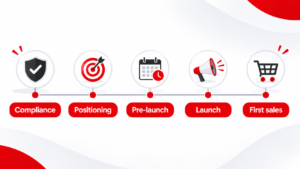
What does a launch timeline look like?
A launch runs in four phases. Dates are relative to the sale date, and the durations are a planning default, not a rule.
| Phase | Timing | Work | Output |
|---|---|---|---|
| Clearance | Day -90 to -60 | Confirm status per SKU, state eligibility, warnings and claims; choose the ship-to states | Signed-off launch brief |
| Foundation | Day -60 to -30 | Build product, range, trust and comparison pages; configure schema, age check and tracking; draft guides | Pages on staging, validated |
| Pre-launch | Day -30 to 0 | Publish trust and guide pages early so they can be crawled; open an email waitlist; brief retailers and distributors; pitch trade press | Indexed pages, consented list, retailer commitments |
| Launch | Day 0 to +14 | Publish product pages, send the launch email, submit URLs, ship to approved states, monitor Search Console and checkout errors | First orders and a clean index |
| Scale | Day +14 to +90 | Add comparison and support content, gather verified reviews, refine pages with query data, outreach for links | Ranking growth and repeat orders |
How do you run email for a vape launch?
Email is the primary owned channel because SMS and paid social are closed. Build the list with an explicit opt-in and an age confirmation, and keep launch emails factual: product name, specifications, availability and the required warning.
- Check your provider first. Acceptable use policies for tobacco and age-restricted brands differ by sender, and some email services restrict or review these accounts. Confirm before you import a list.
- Segment by stated interest. Segment by product type and nicotine strength, not by guesses about the person.
- Keep one welcome sequence. Send a setup guide and a care guide after purchase. This reduces support load and supports reviews.
- Do not market to minors. Do not buy lists or use lookalike audiences built from unverified data.
How do you sell the launch into retailers and distributors?
Physical retail and wholesale are a main route for a vape brand, and the sell-in pack is a marketing asset like any other. Give retailers what they need to list the product lawfully and sell it without questions.
| Asset | Purpose |
|---|---|
| Authorization evidence | Marketing granted order reference, or the pending-application position described accurately |
| State eligibility sheet | States where the product is listed, restricted or excluded |
| Product data feed | Names, GTINs, strengths, images and specifications in one consistent format, so retail sites can publish accurate pages |
| Compliance guidance | Required warnings, age checks and display rules |
| Point-of-sale materials | Counter and shelf material that carries the required warnings and no health claims |
Retailers also publish pages about your product. A clean feed with consistent names and identifiers helps those pages describe the product correctly, and it supports the brand-name searches your launch will generate. Local retail partners should also keep their business listings consistent with your product names.
How should a vape brand handle reviews and creators?
Reviews help conversion and search, but the program must be clean. FDA and FTC sent warning letters in June 2019 to four e-liquid companies whose paid influencer posts lacked the nicotine warning, and the agencies were also pushing for disclosure of paid endorsements. Meta's 2019 policy change targeted influencer branded content for tobacco and vaping. Treat both as the baseline for today.
- Collect reviews from verified buyers on your own product pages, and show only reviews that exist on the page when you mark them up.
- Do not pay or give free product for a promotion without legal review, written disclosure and the required warning in the content.
- Do not use creators under 25 or youth-oriented styles. UK regulators have upheld rulings against vape promotions on TikTok in part for this reason, which shows how regulators view the pattern.
- Moderate user content. Remove claims about health or quitting from comments you host.
How do you earn links and coverage for a launch?
Earned coverage gives a new brand its first authority signals. Aim for relevance over volume.
- Trade press. Pitch industry news outlets that cover product authorizations and retail. A marketing granted order is a real news event, so lead with the facts and the reference.
- Retailer and distributor pages. Ask partners to link to the product page and list the correct names.
- Foundational listings. Complete the company's basic business and manufacturer profiles with matching name, address and contact details.
- Data and explainers. Publish original, sourced material such as a state-by-state availability guide, and update it when rules change.
Which metrics show a launch is working?
| Stage | Metric | Source |
|---|---|---|
| Indexation | Launch URLs indexed; product snippet and breadcrumb items valid | Search Console |
| Visibility | Impressions and rank for brand, product and comparison queries | Search Console and a rank tracker |
| Audience | Waitlist size, opt-in rate and age-confirmation rate | Email platform |
| Conversion | Product page to cart rate; blocked-state checkouts; age-check drop-off | Analytics and checkout logs |
| Retention | Repeat purchase rate, review rate, support tickets per order | Store and help desk |
| Compliance | Pages with warnings in place; flagged claims found in audits | Internal audit log |
What mistakes break vape launches most often?
- Announcing a product before its status is confirmed, then pulling the pages when a supplier's claim proves wrong.
- Planning an SMS or paid social phase that the platforms block, leaving no owned channel ready.
- Using a redirect-style age gate that stops crawlers, so launch pages never rank.
- Marking up reviews, ratings or authorization that the page does not show.
- Launching nationally without checking state directories and flavor rules.
- Skipping the support content, so post-purchase searches go to competitors and forums.
Frequently asked questions
Can I advertise a new vape on Google or Meta? Google's Dangerous products policy lists electronic cigarettes and e-juice among prohibited products, and Meta's ad standards treat e-cigarette promotion as non-compliant. Plan on organic search, email and trade channels instead.
Do I need FDA authorization before I market a vape? New tobacco products need a marketing granted order before they are marketed, and FDA's May 2026 guidance describes enforcement priorities for those that do not have one without making them legal. Ask counsel where each SKU stands before you publish.
Can I use SMS for a vape launch? Major platforms prohibit it. Klaviyo lists tobacco, including vaping, as prohibited SMS content, and other providers state vape and e-cigarettes are not allowed on any number type. Use email.
How early should launch pages go live? Publish trust and guide pages 30 days or more before sale so they can be crawled. Publish product pages on launch day or as soon as the product is lawful to sell in the states you serve.
Can I use influencers? It is a high-risk tactic for this category. Past FDA and FTC warning letters targeted paid posts without the nicotine warning, and platform policies restrict branded content. Get legal review before any creator relationship.
A launch is easiest to run when search, schema and compliance are planned together. Our cover the topical map, launch pages, technical setup and monitoring for new product releases.
Meet Vaibhav Sharma, the visionary owner of Webgeosolution, a cutting-edge AI agency at the forefront of technological innovation. Hailing from the vibrant state of Haryana, Vaibhav's journey into the world of artificial intelligence is nothing short of inspiring. Armed with a Bachelor's degree in Information Technology, Vaibhav embarked on a quest to marry his passion for technology with a desire to push the boundaries of what's possible. His entrepreneurial spirit led him to establish Webgeosolution, where he weaves the magic of artificial intelligence into practical solutions for businesses.
About us and this blog
We are a digital marketing company with a focus on helping our customers achieve great results across several key areas.
Request a free quote
We offer professional SEO services that help websites increase their organic search score drastically in order to compete for the highest rankings even when it comes to highly competitive keywords.
Subscribe to our newsletter!
More from our blog
See all posts


Recent Posts
- Vape Brand Product Launch Marketing November 18, 2026
- Technical SEO & Schema Markup for Vape E-commerce Sites November 18, 2026
- High-Risk Payment Processing for Vape Stores (Compared) November 18, 2026